> For the complete documentation index, see [llms.txt](https://docs.rmhpos.com/llms.txt). Markdown versions of documentation pages are available by appending `.md` to page URLs; this page is available as [Markdown](https://docs.rmhpos.com/readme-1/work-with-work-orders/about-work-orders.md).
# About work orders
This topic describes best practices for working with work orders. Your store may or may not offer work orders. Refer to your store's policies and procedures for work orders.
Generally, **work orders** are created if store employees require additional time to assemble the order for the customer or to pull items from inventory. For example, large items may need to be collected from a nearby warehouse and brought to the store for pick up.
Depending on your store's policies, customers may be required pay a deposit on work orders. If the customer pays a deposit, when they return to pick up the work order you will need to collect the balance owing.
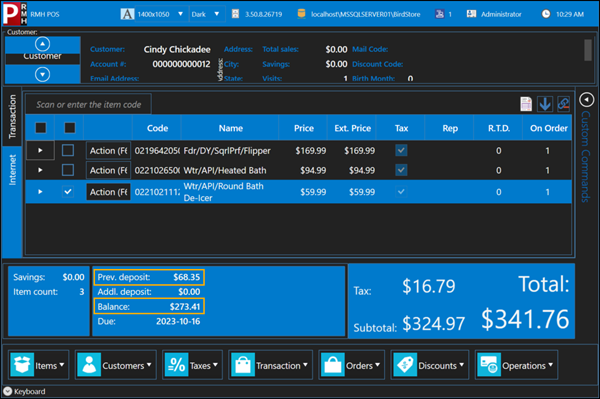
If some items in the work order are available immediately, customers have the option to pick up those items and return at a later time to pick up the remaining items. However, customers must pay the total amount for all items they pick up. If the customer previously paid a deposit, POS calculates how much of the deposit applies to the items the customer is picking up, and the amount due is the total amount minus the applicable deposit.
If the customer has already picked up part of the order, you will see the quantity picked up in the **R.T.D.** (received to date) column. You will see the quantity remaining to be picked up in the **On Order** column. The **Balance** owing is the total amount of the work order minus any deposits or amounts paid previously.
---
# Agent Instructions
This documentation is published with GitBook. GitBook is the documentation platform designed so that both humans and AI agents can read, navigate, and reason over technical content effectively. Learn more at gitbook.com.
## Querying This Documentation
If you need additional information that is not directly available in this page, you can query the documentation dynamically by asking a question.
Perform an HTTP GET request on the current page URL with the `ask` query parameter, and the optional `goal` query parameter:
```
GET https://docs.rmhpos.com/readme-1/work-with-work-orders/about-work-orders.md?ask=&goal=
```
`ask` is the immediate question: it should be specific, self-contained, and written in natural language.
`goal` is optional and describes the broader end goal you are ultimately trying to accomplish on behalf of the user. GitBook uses it to tailor the answer towards what is most useful for that goal.
The response will contain a direct answer to the question and relevant excerpts and sources from the documentation.
Use this mechanism when the answer is not explicitly present in the current page, you need clarification or additional context, or you want to retrieve related documentation sections.