> For the complete documentation index, see [llms.txt](https://docs.rmhpos.com/llms.txt). Markdown versions of documentation pages are available by appending `.md` to page URLs; this page is available as [Markdown](https://docs.rmhpos.com/es/readme-1/work-with-layaways/layaways-creating.md).
# Crear órdenes de apartado
Este tema describe cómo los cajeros, vendedores y gerentes de piso pueden crear órdenes de apartado para los clientes.
1. Toque **Pedidos** | **Apartado**.
{% hint style="info" %}
Sabrás que el POS está en modo de apartado si ves el icono de apartado en la esquina superior derecha de la pantalla.
{% endhint %}
2. (Opcional) Busque al cliente. Consulte [**Buscar clientes**](/es/readme-1/work-with-customers/customers-looking-up.md) para obtener más información.
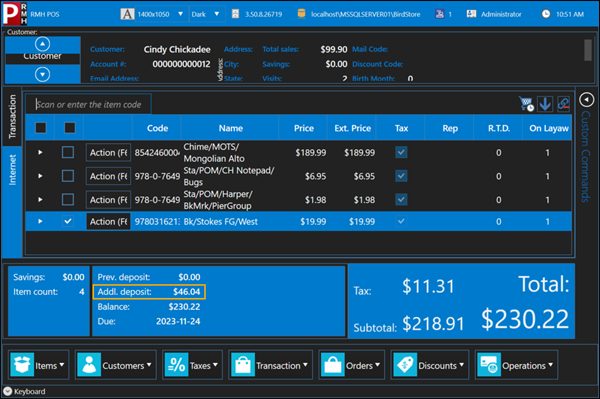
3. Ingrese todos los artículos en el pedido de apartado.
{% hint style="info" %}
Si su tienda requiere que los clientes paguen un depósito por los apartados, el **Depósito adicional** campo indica el **monto mínimo del depósito**. El cliente tiene la opción de pagar más que la cantidad mostrada en el **Depósito adicional** campo.
{% endhint %}
4. Toque **Transacción** | **Cobrar venta**. También puede presionar **F12** o **Intro**.
5. Introduzca el importe junto al tipo de pago correspondiente.
{% hint style="info" %}
Siga las políticas de su tienda con respecto a qué tipos de pago se aceptan para los depósitos de apartados. Por ejemplo, muchas tiendas solo aceptan efectivo, depósito directo o cheque para los depósitos de apartados.
{% endhint %}
6. Toque **Aceptar**.
7. (Opcional) Imprima o envíe por correo electrónico el recibo del cliente.
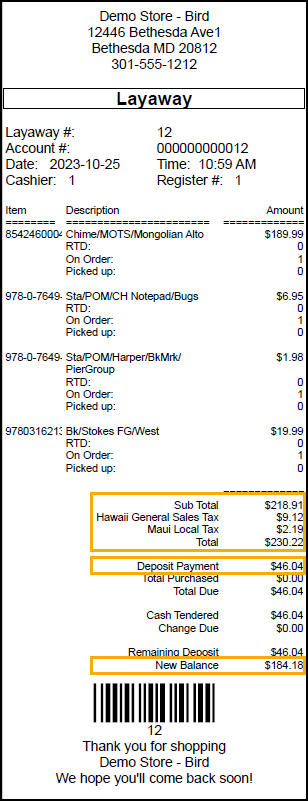
El recibo muestra el importe total del apartado, incluido el impuesto, el importe del depósito y el saldo pendiente del pedido de apartado.
---
# Agent Instructions
This documentation is published with GitBook. GitBook is the documentation platform designed so that both humans and AI agents can read, navigate, and reason over technical content effectively. Learn more at gitbook.com.
## Querying This Documentation
If you need additional information that is not directly available in this page, you can query the documentation by asking a question.
Perform an HTTP GET request on the following URL with the `ask` and `goal` query parameters:
```
GET https://docs.rmhpos.com/es/readme-1/work-with-layaways/layaways-creating.md?ask=&goal=
```
`ask` is the immediate question: it should be specific, self-contained, and written in natural language.
`goal` is what the user is ultimately trying to achieve, the reason they need the answer. Sharing it helps GitBook give you a better, more relevant answer. A goal is most helpful when it describes the outcome the user wants rather than restating the question. For example, with `ask=how do I create an API token`, a goal like `automate deployments from our CI pipeline` lets GitBook tailor the answer to that use case.
The response will contain a direct answer to the question and relevant excerpts and sources from the documentation.
Use this mechanism when the answer is not explicitly present in the current page, you need clarification or additional context, or you want to retrieve related documentation sections.